

La Hermitage of Santa Lucía and Santa Barbara It crowns the highest point of one of the municipality's tallest crags. Standing 163 meters above the slopes of Montgó, this small chapel -owned by the municipality- which, due to its architectural layout, falls within the so-called hermitages of conquest (conquest hermitages). Although the title of the second holy lose strength at the expense of the first, both give the officer the highest chapel of the town name.

the name 'of conquest' it responds to the moment of construction of the same when the settlers coming from the north, and with great Christian tradition, displaced the Muslim population inland and settled their population in the territory, among other things, building hermitages in the shelter of the Montgó.

The documentary archives catalog the construction of the Hermitage of Santa Lucia in the 17th centuryHowever, the hypothesis that it was built much earlier, between the 14th and 15th centuries, is also gaining traction due to the historical moment of the Christian conquest of the territory, the period of settlement and adaptation of the new colonists, and the boom in the construction of these temples of worship and veneration. Hermitage of Santa Lucía and Santa Bárbara is third of the old hermitages existing in Xàbia These are the only ones that remain standing of the four that once existed, and the only one that still maintains its religious practices. Furthermore, archaeological remains of human occupation dating back to prehistoric times have been discovered at this site.

The architecture of St. Lucia
The hermitage of the protector of sight has a architecture simple. It is placed on a rectangular building divided into two sections of about 5 meters separated by a large rough stone arch slightly pointed. Its roof is gabled. At the north end is the altar and to the south, the main entrance which is also framed by a robust semicircular arch on voussoirs (blocks, cubes) of rough stone.

The building would undergo further modifications as are the side cockpits for hermits place (added in the eighteenth century), the naya with beams covering the main entrance in the style of many of the buildings in the village green or modern placeta and stairway arises at his feet created and reformed in recent years.
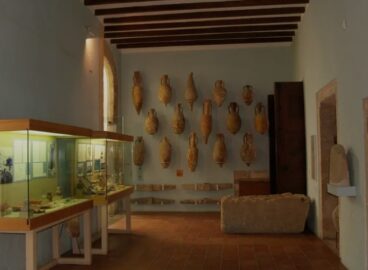
La Bell The bell currently located in Santa Lucía is not the original. Although it only rings once a year—on December 13, the saint's feast day—the original 15th-century Gothic bell is located in the Archaeological and Ethnographic Museum Soler BlascoThis change was made in 2004 to preserve its integrity and conservation.
How to get to
Part of the grace of this hermitage is its 'difficult' access, since it can only be done at aIt is possible to reach the start of the marked trail by vehicle, although there is no parking and no more than three cars can park at its base without obstructing the path or requiring complicated maneuvers to get out.

From this point, the path, steep and inclined, takes about 10 minutes to reach the summit. On December 13th, the day Saint Lucy is celebrated, tradition dictates accompanying her in pilgrimage to the brotherhood from the Church of St. Bartholomewskirting the IES Antoni Llidó and taking the Camí de santa Llúcia...until reaching the summit. A fraternal journey that can be comfortably completed in three-quarters of an hour.

However, except the day of Santa Lucia, is not a busy or crowded chapel the other days of the year so one can venture to approach by car and not have trouble getting in or out. However, for those who do not want to take risks and are willing to walk a path a little longer, the choice is to leave the car in the Plaza of the Constitution and follow the same route of the pilgrimage from there.
Schedules and Masses
The chapel remains closed all year round except for day of their feast (December 13). This is a unique moment because its bell rings - asleep the rest of the year - and Its doors are open to neighbors and participants during the pilgrimage. Furthermore, it is the only day of the year when the images of Saint Lucy and Saint Barbara are carried in procession around the chapel. On that day, as one would expect, a celebration takes place. Eucharist withinThere is a family that keeps the key to the hermitage throughout the year and is responsible for its interior maintenance.

Feast of Saint Lucia and Santa Barbara
The main festival is on December 13th, regardless of whether it falls on a weekend or not. It is not a local holiday, so shops are open and in the colleges It is just another school day, in which many students, accompanied by teachers, take the opportunity to go on a social outing and be part of this celebration.
The celebration of this festival is carried out by a commission of parties, in which new members are added each year, residents of Xàbia who are in charge of preparing the events that comprise this festival.
Previously, a week before, a Eucharist is celebrated in honor of Santa Barbara (patron of the artillery) in the Church of San Bartolomé.
El December 12 It is performed La Call to the Festival consisting of a parade through the streets of the Historic Center announcing the proximity of the big day party and inviting all passersby to donuts and sweet wine. The tour ends with the offering of a bouquet of flowers on the shrine of St. Lucia Street.
The day December 13The day begins with a despertà of rockets and dulzainas by the old townAt 10:00 a.m., the municipal authorities, clergy, the stewards of Santa Lucía, the brotherhood, and the residents begin the pilgrimage to the hermitage from the fortified church of San Bartolomé. Once there, a Eucharist is celebrated (around 11:00 a.m.) in honor of the patron saints, and afterward, the two saints are carried in a small procession around the hermitage, culminating with hot chocolate for all attendees, pastries, and the firing of rockets.
You can consult the complete 2025 program in this post.

Around the chapel
The situation of the chapel does not allow the existence of restaurants, shops or other shops. The closest are in the Plaza de la Constitución and the adjoining streets.
However, the greatest gift of the hermitage's location is its panorama and the tranquility that pervades the place. From its little square. can be seen el Cape San Antonio and the urban center of Aduanas del Mar...as well as the immense Mediterranean Sea, in which, on clear days, the island of Ibiza can be seen. At its feet, the village, the Historic Center and neighborhoods The nearest ones are crowned by San Bartolomé and El Calvario. And in the distance, the third population center, the Arenal.

To the west and northwest, the valley that embraces much of La Marina and of course, the impressive Montgó in a unique view of the great watchman.
-
 Start of the road to the Hermitage of Santa Lucía

-
 Beginning of the path at the foot of the crag
-
 Calvary from Saint Lucia

-
View from St. Lucia
-
 Entrance to the grounds of St. Lucia
-
 The architecture of the chapel responds to the typical hermitages of conquest

-
 The chapel has two invocations

-
 Naya and entrance portico of St. Lucia

-
The hermitage of Saint Lucia belongs to the so-called "hermitages of conquest"

-
The chapel is surrounded by numerous pine

-
Stairway access to the hermitage

-
The Montgó watches her second highest point, the rock of St. Lucia

-
St. Lucia stands at the highest point built in Jávea

-
View of the path that leads to St. Lucia

-
 Views from the Hermitage of Santa Lucía in Xàbia

-
Views from the Hermitage of Santa Lucía in Xàbia

-
View from the Hermitage of Santa Lucía in Xàbia

-
Access to the Hermitage of Santa Lucía in Xàbia

And does anyone know what the strange painting at the entrance means? the one with symbols and colors
It's the Tzolkin calendar but I have no idea why it's there.
The article published by Verónica Blasco on the hermitage of Santa Lucía is worthy of praise and congratulations. This journalist not only reports on the social and political events and activities that take place in Xàbia, but also disseminates and makes known the origin and history of the monuments located in its municipal area, as in the present case. In Xàbia we know the monuments, but we ignore their history. Congratulations.
Thanks, Dad.
Wow! I was just coming to congratulate the writer and I see this comment from her father. It made me so happy. Besides writing very well, Verónica Blasco likes to enrich the content.
Very good article!