Choosing a beach in Xàbia during the summer no longer depends solely on the wind or sea conditions. The presence of jellyfish has become another common concern among locals and tourists. To address this uncertainty, a new initiative was launched. MedusApp, a free application developed by the University of Alicante (UA) and the Polytechnic University of Valencia (UPV) that allows you to know, almost in real time, if there are jellyfish on the beaches thanks to the information provided by the bathers themselves.
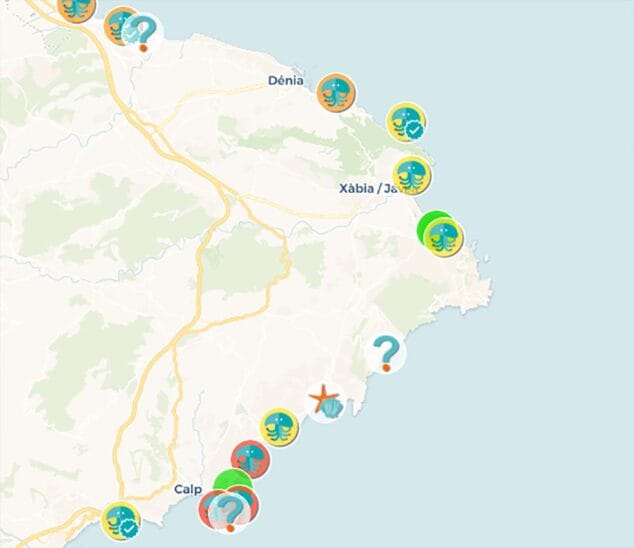
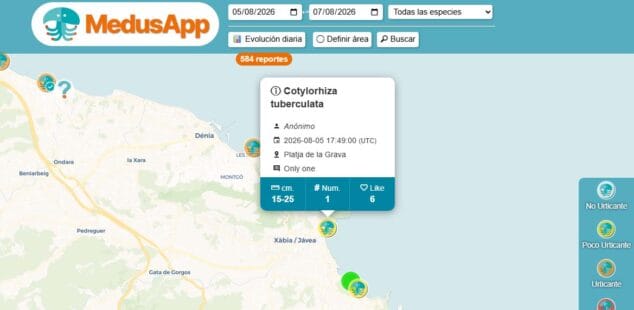
The platform, which has already surpassed 700.000 downloadsThis summer, it incorporates an interactive map where users can consult the recorded sightings and report the presence —or absence— of jellyfish on any beach in the world, including those in Xàbia and the rest of the Marina Alta.
Beachgoers are the ones who keep the app running
One of the main features of MedusApp is that it works through citizen scienceIt is the users themselves who voluntarily report if they have seen jellyfish during their stay at the beach.
As explained by the professor from the Department of Ecology at the University of Alicante, Cesar Bordehore, on Cope, «the 99% of the information The data compiled by the platform comes directly from the contributions of bathers, allowing for the creation of an updated map that serves as a reference for other users."
In addition to the map, the app includes fact sheets to identify the different species, information about their biology, first aid recommendations for bites and stings, and even a system based on Artificial Intelligence capable of recognizing the species from a photography.
A useful tool for the beaches of Xàbia
During the summer months, Xàbia's beaches receive thousands of visitors, and the appearance of jellyfish often generates numerous inquiries to the lifeguards. In this context, apps like MedusApp can become a complementary tool for knowing what's happening at any given moment, although it's always recommended to follow the lifeguards' instructions and respect beach signage.
As it is a collaborative platform, the information is continuously updated as users register new sightings, allowing for a fairly accurate picture of the situation at different points along the coast.
The most common species change
The data collected by MedusApp is also allowing researchers to analyze the evolution of jellyfish in the Mediterranean.
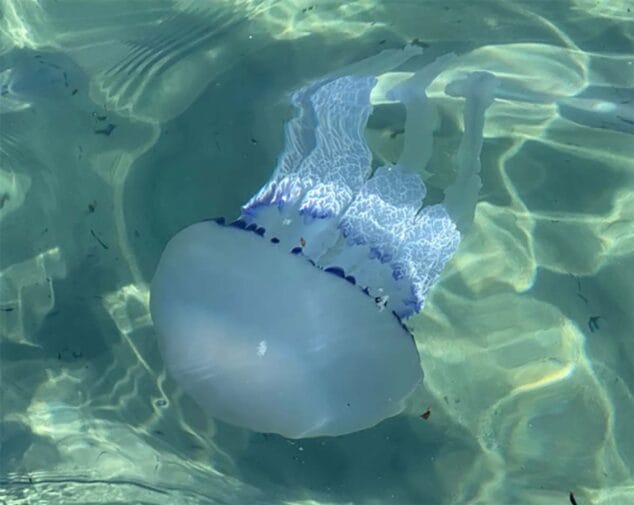
As César Bordehore explained, "the species most reported by users is no longer the well-known carnation jellyfish (Pelagia noctiluca), but the so-called jellyfish fried egg (Cotylorhiza tuberculata), considered much less irritating and easily recognizable by its yellowish appearance."
This change is due to various biological and environmental factors, including the evolution of ocean currents and the increase in water temperature, which is modifying the development cycles of some species.
The warmth of the sea brings forward its appearance
Experts indicate that rising Mediterranean temperatures are accelerating jellyfish growth, causing large specimens to appear earlier than usual. This means their presence increasingly coincides with peak bathing season, especially during July and August.
What to do if you find a jellyfish?
Experts emphasize one basic recommendation: Never touch a jellyfisheven if it appears dead or is found stranded on the sand.
In case of detecting a Portuguese caravelConsidered one of the most dangerous species that can occasionally reach the Mediterranean coast, the recommendation is not to enter the water and to immediately notify the lifeguard services so that they can act safely.
Beyond consulting the app, experts remind us that the best information continues to be that offered by beach surveillance teams, responsible for evaluating bathing conditions at all times and ensuring the safety of users.