

Hay stories that remain for centuries beneath our feet and others that survive, literally, among old papers. A collection of old newspaper clippings given to Arxiu Municipal Xàbia by Godofredo Cruanes has once again brought attention to one of the most dramatic and difficult episodes of the history From Xàbia: the entry of hundreds of Migueletes, the looting of the church in 1707, the taking of hostages and a population trapped in the middle of the War of Succession.
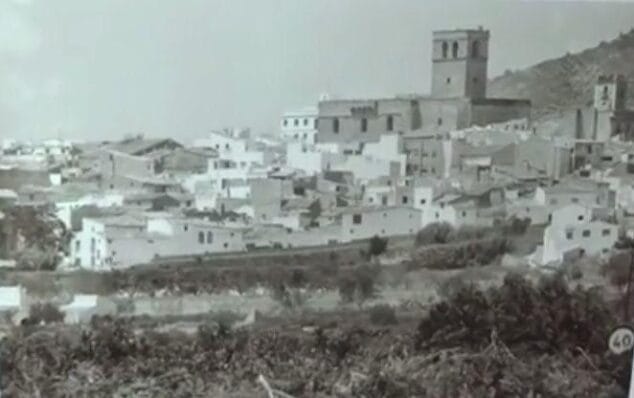
The recovered narrative comes from a historical article, written by Vicente Boix, published decades ago —among the clippings there is a reference to Future, dated in Alicante in 1920— which reconstructs, in a language typical of its time, those turbulent days of the War of the Spanish Succession.
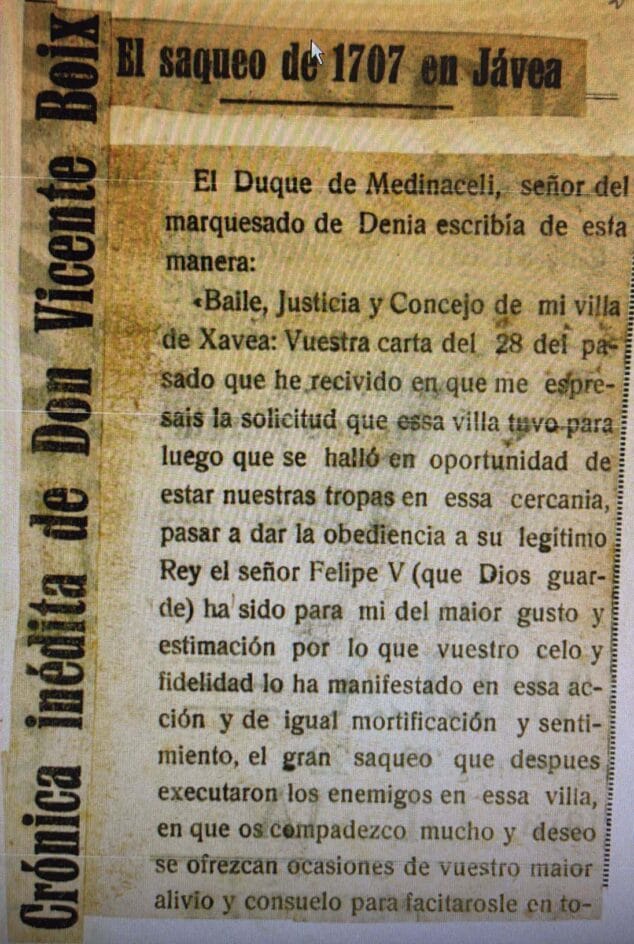
The looting that terrorized Xàbia for seven days in 1707
During seven daysXàbia was left at the mercy of some 400 menThey looted the churchThey took the bells and valuables, took hostages and forced part of the population into hiding. It was June 1707 and the War of succession had fully arrived at the village.
More than three centuries later, old newspaper clippings allow us to recover the story of those days and reconstruct one of the most violent episodes that Xàbia experienced at the beginning of the 18th century.
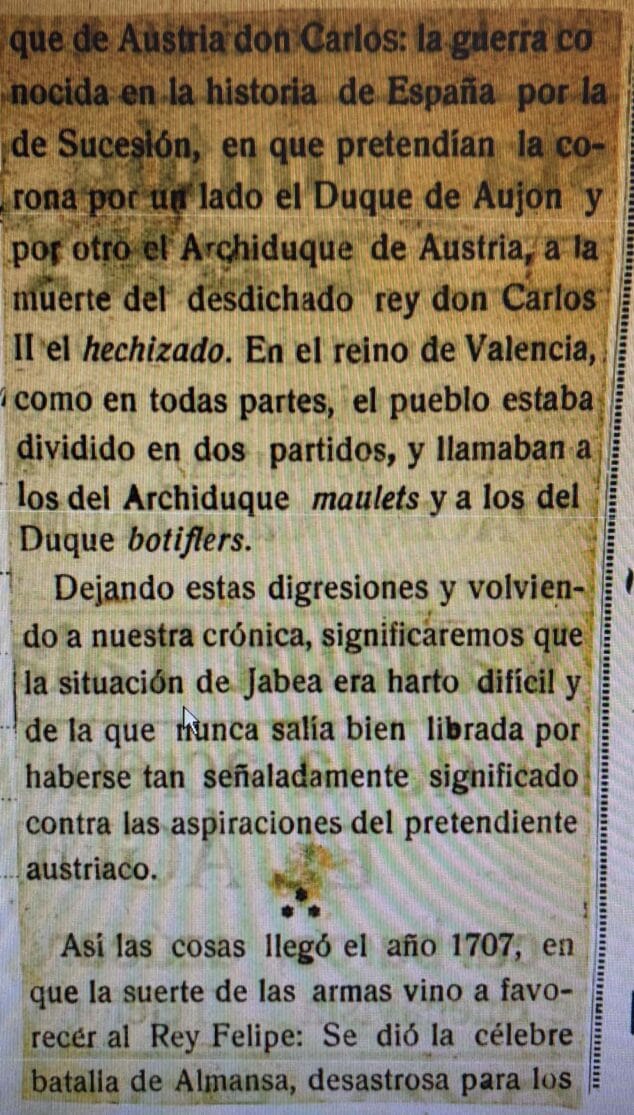
The story is set in the middle fight for the Spanish Crown after the death of Charles IIPhilip of Bourbon, the future Philip V, and Archduke Charles of Austria were vying for the throne in a war that also divided the Kingdom of Valencia. Xàbia sided with Philip V. That decision would have consequences.
A villa in the crosshairs
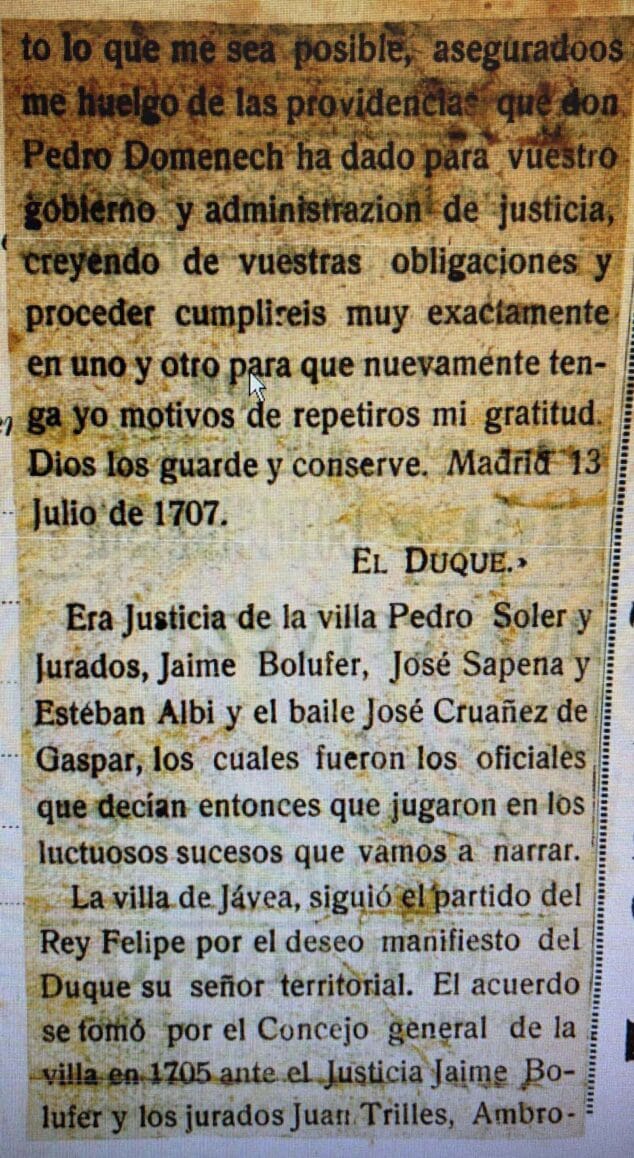
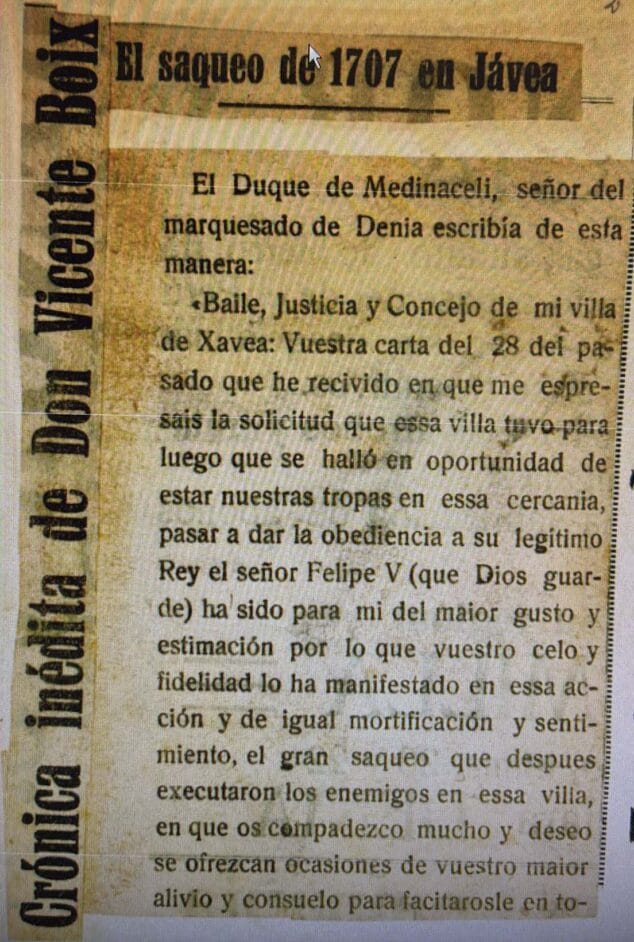
The town had shown its loyalty to the Bourbon cause years before the sacking. According to the documents collected in the newspaper clippings, the town council had communicated its allegiance to the Duke of Medinaceli, territorial lord of Xàbia, who in turn conveyed that support to the monarch.
Meanwhile, in much of the Valencian territory, the movement in favor of Archduke Charles was gaining strength. Its supporters were known as maulets, in contrast to the followers of Philip V, identified as botiflers.

The war gradually approached the Marina Alta region.After the Battle of Almansa in April 1707, the Bourbon forces began to regain ground, but Dénia remained one of the main Austrian strongholds in the area. It was in this context that the attack on Xàbia took place.
June 22, 1707: The looting begins
The cuts place the start of the occupation on 22 June, 1707. Some 400 migueletes supporters of the archduke They violently entered Xàbia and remained in the town until the 28th.
According to the historical account itself, they were seven days of "anxiety and suffering"The objective was not solely military.

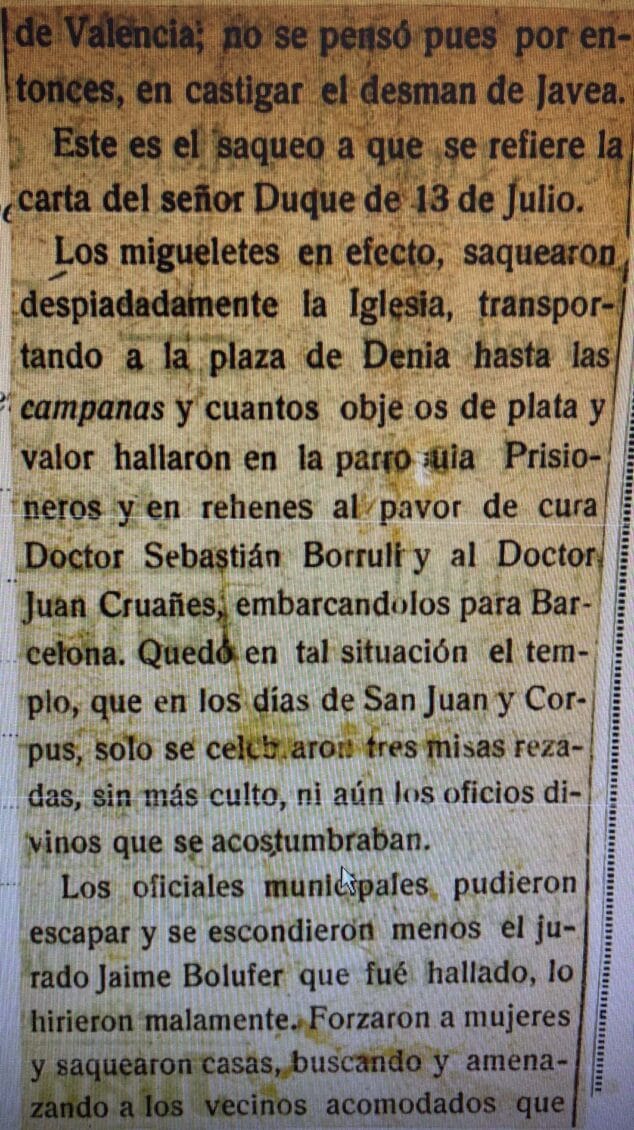
The church of Xàbia suffered a major lootingThe attackers stole valuables, silverware, and even the church bells, which were later reportedly taken to Dénia. The consequences were immediately felt in the daily lives of the population. On important dates such as Saint John's Day and Corpus Christi, religious activity was reduced to practically nothing.
Hostages, escapes, and violence among the population
The occupation also directly impacted the authorities and residents. Some municipal officers managed to escape and hide before being located by the attackers. Not everyone was so lucky. The jury Jaime Bolufer He was found and seriously injured.
The documentation also mentions the arrest of the parish priest. Sebastian Borrull and from the doctor Juan Cruañes, who were taken hostage and sent to Barcelona.
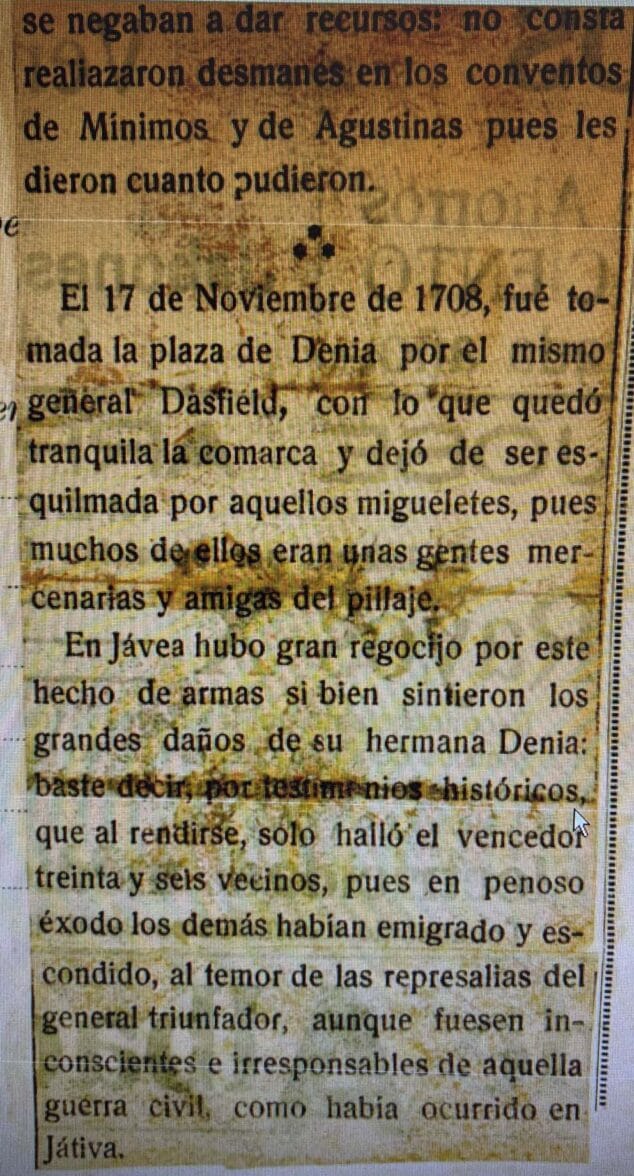
The report also includes threats against wealthy residents, looting of homes, and episodes of violence against the population. The Minim and Augustinian convents, however, reportedly avoided further damage after providing resources to the attackers.
It was, in short, a town subjected to a war that was no longer fought solely on the great battlefields. The war had reached their streets and their homes.
Xàbia paid dearly for its support of Philip V
The attack was not random. Xàbia had been clearly identified. with the Bourbon cause and was located very close to Dénia, one of the main centers of Austrian resistance in the area.
The sack of 1707 thus occurred within the conflict between the supporters of both claimants to the throne. The situation in the region began to change definitively the following year. Dénia fell to the Bourbons on November 17th 1708This significantly reduced the Austrian presence in the area. For Xàbia, this marked the end of some of the most turbulent years in its history.
Philip V's reward came later
The town's loyalty to Philip V was eventually recognized by the Crown. In 1710, the king granted Xàbia the title of 'Most Loyal'A few months later, in January 1711, the town received another privilege allowing it to incorporate a fleur-de-lis on his heraldic shield, a symbol linked to the Bourbon dynasty.
The press, which decades later would revisit these events, summed it up with a powerful phrase: "The King's prize went to Jávea"But those accolades could not erase what had happened.
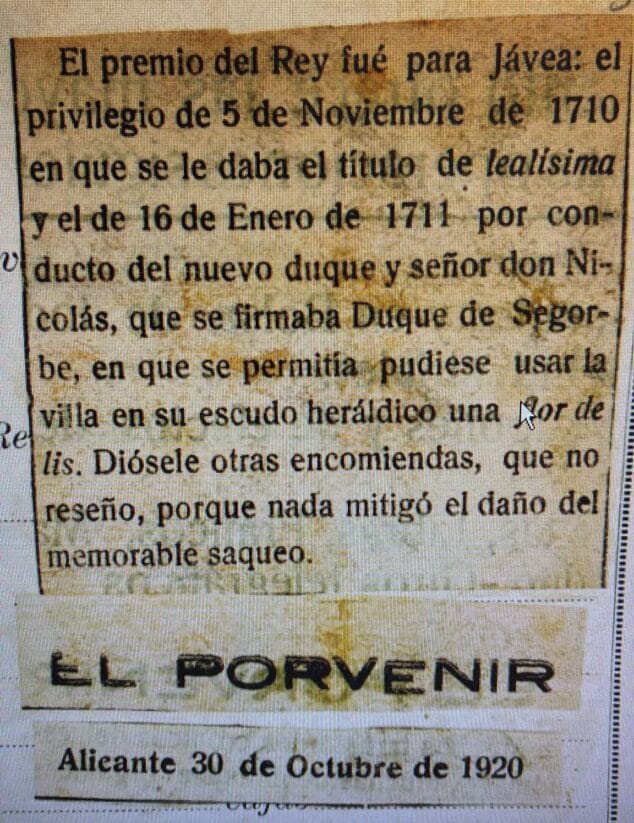
The historical account itself indicates that the rewards subsequently granted did not compensate for the damage caused by what came to be remembered as "the memorable looting".
A story recovered more than 300 years later
The recovery of these old clippings provides a twofold perspective on that episode.On the one hand, it allows us to explore one of the most violent chapters in Xàbia's history at the beginning of the 18th century and learn about some of the names, dates, and events that marked those days. On the other hand, the documents reveal how that story continued to form part of the local memory long afterward and how it was reported by the press of another era.
Annotations
It should be noted, within the context of journalistic texts, that some of the expressions used to refer to the different sides and the protagonists of the conflict reflect the vision political and the social context of the time in which the articles were written, rather than a neutral account of events. But behind that way of telling the story lies an episode that marked the town: In June 1707, for seven days, the War of Succession fully entered Xàbia.
More than three centuries later, some old newspaper clippings now preserved in the Municipal Archive bring that looting back into the eyes of the people of Xàbia.
-
 Newspaper clipping about looting - part 4 - | Photo AMX
-
 Newspaper clipping of looting - part 3 - | Photo AMX

-
 Newspaper clipping of looting - part 2 - | Photo AMX
-
 Newspaper clipping of looting -part 1- | Photo AMX
-
 Newspaper clipping about looting - part 5 - | Photo AMX

-
 Newspaper clipping about looting - part 6 - | Photo AMX
-
 Newspaper clipping about looting - part 7 - | Photo AMX
-
 Newspaper clipping about looting - part 8 - | Photo AMX






Jávea suffered that looting because of a fight between would-be kings. No town should ever have to suffer because of the self-interest of would-be kings who weren't even Spanish. Kings, princes, and princesses belong in children's stories.
Thank you so much. It's always nice to go to bed having learned something new, even if it's a very sad story.